Showing posts with label fraud. Show all posts

Monday, February 28, 2011

More Hospitals Settle, But Not for Much

In late February, there have been several notable legal settlements made by more or less prominent hospitals, discussed in rough order of size.

United Regional Health Care System

Per the Cypress Times,
The Department of Justice announced today that it has reached a settlement with United Regional Health Care System of Wichita Falls, Texas, that prohibits it from entering into contracts that improperly inhibit commercial health insurers from contracting with United Regional’s competitors. The department said that United Regional unlawfully used these contracts to maintain its monopoly for hospital services in violation of Section 2 of the Sherman Act, causing consumers to pay higher prices for health care services.

Note that this appears to be the first settlement involving the Sherman Anti-Trust Act that included a hospital system, or any health care organization which we have discussed. As the Times article mentioned,
This is the first case brought by the department since 1999 that challenges a monopolist with engaging in traditional anticompetitive unilateral conduct.

Here is more detail about the alleged offenses:
According to the complaint, United Regional is by far the largest hospital in Wichita Falls. Its share of general acute-care inpatient hospital services is approximately 90 percent, and its share of outpatient surgical services is more than 65 percent. It is the region’s only provider of certain essential services such as cardiac surgery, obstetrics and high-level trauma care. In Wichita Falls, United Regional’s average per-day rate for inpatient hospital services sold to commercial health insurers is about 70 percent higher than its closest competitor for the services that are offered by both hospitals.

The department said that in order to maintain its monopoly in the provision of inpatient hospital and outpatient surgical services, United Regional systematically required most commercial health insurers to enter into contracts that effectively prohibited them from contracting with United Regional’s competitors. United Regional’s contracts required these insurers to pay significantly higher prices if they contracted with a nearby competing facility. Since United Regional is a must-have hospital for any insurer that wants to sell health insurance in the Wichita Falls area, and because the penalty for contracting with United Regional’s rivals was so significant, almost all insurers offering health insurance in Wichita Falls entered into exclusionary contracts with United Regional. As a result, competing hospitals and facilities could not obtain contracts with most insurers and were less able to compete, helping United Regional maintain its monopoly in the relevant markets and raising health-care costs to the detriment of consumers.

As far as I could tell, however, for this apparently severe offense there will be no actual penalty. The settlement only appears to provide for a promised change in future behavior by the hospital:
The proposed settlement, which if accepted by the court would be in effect for seven years, restores lost competition by prohibiting United Regional from using agreements with commercial health insurers that improperly inhibit insurers from contracting with United Regional’s competitors. In particular, United Regional is prohibited from conditioning the prices or discounts that it offers to commercial health insurers based on whether those insurers contract with other health-care providers and from inhibiting insurers from entering into agreements with United Regional’s rivals. United Regional is also prohibited from taking any retaliatory actions against an insurer that enters into an agreement with a rival provider.

So if a hospital engages in actions that restrain competition and results in a de facto monopoly, all the hospital leaders must fear is that at some point it may have to change its monopolistic behavior, according to this settlement.

Catholic Healthcare West

Per the San Jose Business Journal,
Catholic Healthcare West, parent company to local Mercy hospitals, has agreed to pay $9.1 million to settle allegations that seven of its hospitals submitted false Medicare claims, U.S. Attorney Benjamin Wagner announced late Friday.

Here is more detail about the alleged offenses:
The hospitals include Community Hospital of San Bernardino, St. Bernadine Medical Center in San Bernardino and St. Elizabeth Community Hospital in Red Bluff.

The settlement also included allegations that O’Conner Hospital in San Jose, Seton Medical Center in Daly City and St. Joseph’s Hospital and Medical Center in Phoenix submitted inflated costs for their home health agencies and were overpaid. The agreement also resolves allegations that St. Joseph’s overstated how much was owed in disproportionate share funding for indigent patients.

CHW no longer owns O’Conner Hospital or Seton Medical Center.

The settlement resolves allegations that St. John’s Regional Medical Center in Oxnard was overpaid for treating a high percentage of patients with end-stage kidney disease for several years, including two when it was not eligible.

Note that while the amount of the payment assessed appears substantial, it will be made a very long time after the alleged bad behavior occurred:
All of the problems occurred in the 1990s. Federal investigators began looking into the matter in 2001, but it took years to compile evidence and reach a settlement. All of the hospitals had set aside money in a reserve account should they have to pay funds back to the government.

So if a hospital submits false claims to the US government, hospital leaders need not fear paying anything back for more than 10 years, according to this settlement.

By the way, this was not the first such settlement that Catholic Healthcare West has had to make:
In 1998, a whistleblower at Woodland Healthcare disclosed instances of alleged fraud by two medical groups affiliated with local Mercy hospitals, Woodland Clinic Medical Group and Medical Clinic of Sacramento.

Following an extensive investigation, former U.S. Attorney John Vincent announced a $10.25 million settlement in May 2001. The allegations included false claims to inflate reimbursement from Medicare, Medi-Cal and military health insurance programs.

Massachusetts General Hospital (Partners Healthcare)

Per the Boston Globe,
Massachusetts General Hospital has agreed to pay the federal government $1 million to settle potential violations of patient privacy laws, which occurred when an employee commuting to work lost patient records on the T’s Red Line two years ago.

Here is more detail about the alleged offenses:
Health information for 192 patients in Mass General’s Infectious Disease Associates outpatient practice was lost in the incident, including that of patients with HIV/AIDS. The documents included a patient schedule containing names and patient medical record numbers, as well as billing forms containing the name, birth date, medical record number, health insurer and policy number, diagnosis, and name of providers for 66 of those patients.

Note that Massachusetts General Hospital is not independent, but part of Partners Healthcare, which reported net patient service revenue of $1.5 billion in the most recent quarter, again per the Boston Globe. So this settlement amounted to about 0.00167% of the system's patient revenue.

So if a hospital engages in actions that violate the trust patients have that their information will be kept confidential, all hospital leaders have to fear is that their institution will eventually have to pay something much less than round-up error of their revenue, according to this settlement.

Summary

Again, the volume of participants in the ongoing march of legal settlements is a reminder of how pervasive bad behavior is in the US health care system. Remember that these settlements are in some sense the tip of the iceberg. They only indicate behavior that inspired legal action which was in turn was publicized. It is likely that for each behavior that eventually leads to a settlement, there are many behaviors that go unreported, or that cause no reaction.

It is interesting that sorts of bad behavior that formerly caused no official reaction are now leading to settlements. As noted above, there had been no recent legal actions against concentration of power in health care up to the United Regional Health Care System settlement.

However, like many of the settlements we have previously noted, the latest crop seem to have little deterrent power. The United Regional Health Care System settlement seemingly involved no monetary penalties whatsoever, only a promise of not to do it again. The Catholic Healthcare West settlement's monetary penalties were so delayed, occurring over 10 years after the actions in question, their deterrent power is highly questionable. The Massachusetts General Hospital (really the Partners Healthcare) monetary penalty was infinitesimal compared to the size of the institution's budget.

Furthermore, as in nearly every other case we have reported, no person who authorized, directed or implemented the actions in question had to pay any penalty, or suffer any negative consequence, or was even identified.

So while there seems to be some increased interest in addressing some kinds of bad behavior, like monopolistic practices, that heretofore generated no official reactions, regulatory authorities still seem loathe to even slap the wrists of the people whose aggregated actions are making our health care so expensive, so inaccessible, and probably of such mediocre quality.

Thus, in recent years, health care leaders, like leaders of financial service companies, seem to have impunity,  Up to now, they have been able to preside over all sorts of bad behaviors that help support their exorbitant remuneration without fearing any personal penalties.  As Charles Ferguson, the director of Inside Job, said when accepting his Academy Award last night, per MarketWatch,
Forgive me, I must start by pointing out that three years after a horrific financial crisis caused by fraud, not a single financial executive has gone to jail — and that’s wrong

After a slow-motion health care train wreck over the last 30 years, hardly any health care executives have even had to pay a fine, much less go to jail.

So I repeat, and repeat, and repeat: we will not deter unethical behavior by health care organizations until the people who authorize, direct or implement bad behavior fear some meaningfully negative consequences. Real health care reform needs to make health care leaders accountable, and especially accountable for the bad behavior that helped make them rich.

More Hospitals Settle, But Not for Much

In late February, there have been several notable legal settlements made by more or less prominent hospitals, discussed in rough order of size.

United Regional Health Care System

Per the Cypress Times,
The Department of Justice announced today that it has reached a settlement with United Regional Health Care System of Wichita Falls, Texas, that prohibits it from entering into contracts that improperly inhibit commercial health insurers from contracting with United Regional’s competitors. The department said that United Regional unlawfully used these contracts to maintain its monopoly for hospital services in violation of Section 2 of the Sherman Act, causing consumers to pay higher prices for health care services.

Note that this appears to be the first settlement involving the Sherman Anti-Trust Act that included a hospital system, or any health care organization which we have discussed. As the Times article mentioned,
This is the first case brought by the department since 1999 that challenges a monopolist with engaging in traditional anticompetitive unilateral conduct.

Here is more detail about the alleged offenses:
According to the complaint, United Regional is by far the largest hospital in Wichita Falls. Its share of general acute-care inpatient hospital services is approximately 90 percent, and its share of outpatient surgical services is more than 65 percent. It is the region’s only provider of certain essential services such as cardiac surgery, obstetrics and high-level trauma care. In Wichita Falls, United Regional’s average per-day rate for inpatient hospital services sold to commercial health insurers is about 70 percent higher than its closest competitor for the services that are offered by both hospitals.

The department said that in order to maintain its monopoly in the provision of inpatient hospital and outpatient surgical services, United Regional systematically required most commercial health insurers to enter into contracts that effectively prohibited them from contracting with United Regional’s competitors. United Regional’s contracts required these insurers to pay significantly higher prices if they contracted with a nearby competing facility. Since United Regional is a must-have hospital for any insurer that wants to sell health insurance in the Wichita Falls area, and because the penalty for contracting with United Regional’s rivals was so significant, almost all insurers offering health insurance in Wichita Falls entered into exclusionary contracts with United Regional. As a result, competing hospitals and facilities could not obtain contracts with most insurers and were less able to compete, helping United Regional maintain its monopoly in the relevant markets and raising health-care costs to the detriment of consumers.

As far as I could tell, however, for this apparently severe offense there will be no actual penalty. The settlement only appears to provide for a promised change in future behavior by the hospital:
The proposed settlement, which if accepted by the court would be in effect for seven years, restores lost competition by prohibiting United Regional from using agreements with commercial health insurers that improperly inhibit insurers from contracting with United Regional’s competitors. In particular, United Regional is prohibited from conditioning the prices or discounts that it offers to commercial health insurers based on whether those insurers contract with other health-care providers and from inhibiting insurers from entering into agreements with United Regional’s rivals. United Regional is also prohibited from taking any retaliatory actions against an insurer that enters into an agreement with a rival provider.

So if a hospital engages in actions that restrain competition and results in a de facto monopoly, all the hospital leaders must fear is that at some point it may have to change its monopolistic behavior, according to this settlement.

Catholic Healthcare West

Per the San Jose Business Journal,
Catholic Healthcare West, parent company to local Mercy hospitals, has agreed to pay $9.1 million to settle allegations that seven of its hospitals submitted false Medicare claims, U.S. Attorney Benjamin Wagner announced late Friday.

Here is more detail about the alleged offenses:
The hospitals include Community Hospital of San Bernardino, St. Bernadine Medical Center in San Bernardino and St. Elizabeth Community Hospital in Red Bluff.

The settlement also included allegations that O’Conner Hospital in San Jose, Seton Medical Center in Daly City and St. Joseph’s Hospital and Medical Center in Phoenix submitted inflated costs for their home health agencies and were overpaid. The agreement also resolves allegations that St. Joseph’s overstated how much was owed in disproportionate share funding for indigent patients.

CHW no longer owns O’Conner Hospital or Seton Medical Center.

The settlement resolves allegations that St. John’s Regional Medical Center in Oxnard was overpaid for treating a high percentage of patients with end-stage kidney disease for several years, including two when it was not eligible.

Note that while the amount of the payment assessed appears substantial, it will be made a very long time after the alleged bad behavior occurred:
All of the problems occurred in the 1990s. Federal investigators began looking into the matter in 2001, but it took years to compile evidence and reach a settlement. All of the hospitals had set aside money in a reserve account should they have to pay funds back to the government.

So if a hospital submits false claims to the US government, hospital leaders need not fear paying anything back for more than 10 years, according to this settlement.

By the way, this was not the first such settlement that Catholic Healthcare West has had to make:
In 1998, a whistleblower at Woodland Healthcare disclosed instances of alleged fraud by two medical groups affiliated with local Mercy hospitals, Woodland Clinic Medical Group and Medical Clinic of Sacramento.

Following an extensive investigation, former U.S. Attorney John Vincent announced a $10.25 million settlement in May 2001. The allegations included false claims to inflate reimbursement from Medicare, Medi-Cal and military health insurance programs.

Massachusetts General Hospital (Partners Healthcare)

Per the Boston Globe,
Massachusetts General Hospital has agreed to pay the federal government $1 million to settle potential violations of patient privacy laws, which occurred when an employee commuting to work lost patient records on the T’s Red Line two years ago.

Here is more detail about the alleged offenses:
Health information for 192 patients in Mass General’s Infectious Disease Associates outpatient practice was lost in the incident, including that of patients with HIV/AIDS. The documents included a patient schedule containing names and patient medical record numbers, as well as billing forms containing the name, birth date, medical record number, health insurer and policy number, diagnosis, and name of providers for 66 of those patients.

Note that Massachusetts General Hospital is not independent, but part of Partners Healthcare, which reported net patient service revenue of $1.5 billion in the most recent quarter, again per the Boston Globe. So this settlement amounted to about 0.00167% of the system's patient revenue.

So if a hospital engages in actions that violate the trust patients have that their information will be kept confidential, all hospital leaders have to fear is that their institution will eventually have to pay something much less than round-up error of their revenue, according to this settlement.

Summary

Again, the volume of participants in the ongoing march of legal settlements is a reminder of how pervasive bad behavior is in the US health care system. Remember that these settlements are in some sense the tip of the iceberg. They only indicate behavior that inspired legal action which was in turn was publicized. It is likely that for each behavior that eventually leads to a settlement, there are many behaviors that go unreported, or that cause no reaction.

It is interesting that sorts of bad behavior that formerly caused no official reaction are now leading to settlements. As noted above, there had been no recent legal actions against concentration of power in health care up to the United Regional Health Care System settlement.

However, like many of the settlements we have previously noted, the latest crop seem to have little deterrent power. The United Regional Health Care System settlement seemingly involved no monetary penalties whatsoever, only a promise of not to do it again. The Catholic Healthcare West settlement's monetary penalties were so delayed, occurring over 10 years after the actions in question, their deterrent power is highly questionable. The Massachusetts General Hospital (really the Partners Healthcare) monetary penalty was infinitesimal compared to the size of the institution's budget.

Furthermore, as in nearly every other case we have reported, no person who authorized, directed or implemented the actions in question had to pay any penalty, or suffer any negative consequence, or was even identified.

So while there seems to be some increased interest in addressing some kinds of bad behavior, like monopolistic practices, that heretofore generated no official reactions, regulatory authorities still seem loathe to even slap the wrists of the people whose aggregated actions are making our health care so expensive, so inaccessible, and probably of such mediocre quality.

Thus, in recent years, health care leaders, like leaders of financial service companies, seem to have impunity,  Up to now, they have been able to preside over all sorts of bad behaviors that help support their exorbitant remuneration without fearing any personal penalties.  As Charles Ferguson, the director of Inside Job, said when accepting his Academy Award last night, per MarketWatch,
Forgive me, I must start by pointing out that three years after a horrific financial crisis caused by fraud, not a single financial executive has gone to jail — and that’s wrong

After a slow-motion health care train wreck over the last 30 years, hardly any health care executives have even had to pay a fine, much less go to jail.

So I repeat, and repeat, and repeat: we will not deter unethical behavior by health care organizations until the people who authorize, direct or implement bad behavior fear some meaningfully negative consequences. Real health care reform needs to make health care leaders accountable, and especially accountable for the bad behavior that helped make them rich.

Saturday, February 19, 2011

Dr. Ross Koppel: Another Angle on EMR-Incited Upcoding

At my Feb. 15, 2011 post "Does EHR-Incited Upcoding (Also Known as "Fraud") Need Investigation by CMS?" I explained how, based on data I received from an active ED physician, EHR's and their algorithmic "billing advice" tools were apparently inciting massive upcoding.

The upcoding was causing a huge spike in "level 4" and "level 5" determinations for ED billing when comparing 2002 data to 2008 data, with resultant billions of dollars of increased Medicare expenditure for a few extra mouse clicks. See the above post for details, as shown on the graphs below:


(E/M level increases, 2002 compared to 2008. Click to enlarge)


(Est. increased Medicare expenditures from EHR upcoding, comparing 2002 to 2008. Click to enlarge)


Another angle on EHR-incited upcoding comes from University of Pennsylvania sociologist and EHR expert Ross Koppel, PhD. His words are reproduced with his permission below.

First, Dr. Koppel was quoted in today's Wall Street Journal in an article entitled "Many Medical Bills Contain Errors That Could End Up Wrecking Your Credit Score, Here's What You Need to Know" by Jessica Silver-Greenberg:

... What's more, some health-care experts say the number of errors could jump in coming years. That's because the 2009 economic-stimulus legislation included $19 billion in spending to encourage the use of electronic health records—a major source of billing mistakes, says Ross Koppel, a sociology professor at University of Pennsylvania's Center for Clinical Epidemiology and Biostatistics who has studied electronic records extensively.

Dr. Koppel adds the following commentary for HC Renewal:

With several EHRs, there's "auto-fill" for the EHR that reports on parts of the body the physician does not examine. So, for example, if the physician is a hand specialist, she/he will probably not examine the legs, head, chest, back, etc.

On many EHRs this is listed [e.g., entered by the user through clicking a form or checkbox - ed.] as "unremarkable" which in medical-speak means "I've examined these organs/body parts and found no problems."

In billing terms, that means "I've examined these parts and should be paid for a more comprehensive visit....what's called "up-coding."

It's actually dangerous for physicians because if the patient next week walks in with a major tumor that the doc should obviously have seen (had she/he examined that body part) then the physician is on the line and can get sued.

On other other hand, if the unexamined parts don't turn up in a medical case, it means the doc will make more money...with the only danger to the doc that she/he can be charged with fraud by the government and or by a payer.

So, in effect, today's EHR's, not just through algorithmic "recommendations" for upcoding but also through their template-checkbox nature, incite upcoding.

The resultant increased expenditures do not reflect more medical care provided or cognitive processes utilized, but merely a small amount of elbow, carpal and index finger activity:


Click...click...an easy way to generate billions of dollars of additional billing?

-- SS


Dr. Ross Koppel: Another Angle on EMR-Incited Upcoding

At my Feb. 15, 2011 post "Does EHR-Incited Upcoding (Also Known as "Fraud") Need Investigation by CMS?" I explained how, based on data I received from an active ED physician, EHR's and their algorithmic "billing advice" tools were apparently inciting massive upcoding.

The upcoding was causing a huge spike in "level 4" and "level 5" determinations for ED billing when comparing 2002 data to 2008 data, with resultant billions of dollars of increased Medicare expenditure for a few extra mouse clicks. See the above post for details, as shown on the graphs below:


(E/M level increases, 2002 compared to 2008. Click to enlarge)


(Est. increased Medicare expenditures from EHR upcoding, comparing 2002 to 2008. Click to enlarge)


Another angle on EHR-incited upcoding comes from University of Pennsylvania sociologist and EHR expert Ross Koppel, PhD. His words are reproduced with his permission below.

First, Dr. Koppel was quoted in today's Wall Street Journal in an article entitled "Many Medical Bills Contain Errors That Could End Up Wrecking Your Credit Score, Here's What You Need to Know" by Jessica Silver-Greenberg:

... What's more, some health-care experts say the number of errors could jump in coming years. That's because the 2009 economic-stimulus legislation included $19 billion in spending to encourage the use of electronic health records—a major source of billing mistakes, says Ross Koppel, a sociology professor at University of Pennsylvania's Center for Clinical Epidemiology and Biostatistics who has studied electronic records extensively.

Dr. Koppel adds the following commentary for HC Renewal:

With several EHRs, there's "auto-fill" for the EHR that reports on parts of the body the physician does not examine. So, for example, if the physician is a hand specialist, she/he will probably not examine the legs, head, chest, back, etc.

On many EHRs this is listed [e.g., entered by the user through clicking a form or checkbox - ed.] as "unremarkable" which in medical-speak means "I've examined these organs/body parts and found no problems."

In billing terms, that means "I've examined these parts and should be paid for a more comprehensive visit....what's called "up-coding."

It's actually dangerous for physicians because if the patient next week walks in with a major tumor that the doc should obviously have seen (had she/he examined that body part) then the physician is on the line and can get sued.

On other other hand, if the unexamined parts don't turn up in a medical case, it means the doc will make more money...with the only danger to the doc that she/he can be charged with fraud by the government and or by a payer.

So, in effect, today's EHR's, not just through algorithmic "recommendations" for upcoding but also through their template-checkbox nature, incite upcoding.

The resultant increased expenditures do not reflect more medical care provided or cognitive processes utilized, but merely a small amount of elbow, carpal and index finger activity:


Click...click...an easy way to generate billions of dollars of additional billing?

-- SS


Friday, February 18, 2011

Massive Nationwide Medicare Bust: 111 Charged For Scams Worth $225 Million

The article "Massive Nationwide Medicare Bust: 111 Charged For Scams Worth $225 Million" in the HuffPo reports that:

MIAMI — Federal authorities charged more than 100 doctors, nurses and physical therapists in nine cities with Medicare fraud Thursday, part of a massive nationwide bust that snared more suspects than any other in history.

More than 700 law enforcement agents fanned out to arrest dozens of people accused of illegally billing Medicare more than $225 million. The arrests are the latest in a string of major busts in the past two years as authorities have struggled to pare the fraud that's believed to cost the government between $60 billion and $90 billion each year. Stopping Medicare's budget from hemorrhaging that money will be key to paying for President Barack Obama's health care overhaul ...


Read the entire story at the link above.

As I wrote at my Feb. 15, 2010 post "Does Possible EMR-Facilitated Upcoding (Also Known as "Fraud") Need Investigation by CMS, And Could it Explain HIT Irrational Exuberance?", those "Federal authorities" need to look into how EHR's facilitate upcoding, which is a form of fraud that is likely worth far, far more than a mere $225 million:

(Click to enlarge. $225 million might be mere chicken feed. See here.)


Worse, without careful scrutiny, EHR-mediated fraud might not be as easily detected as the "conventional" Medicare fraud mills, where, for example, it can get highly obvious something's amiss:

... A Brooklyn, N.Y., proctologist was charged with billing $6.5 million for hemorrhoid removals, most of which he never performed.

Finally, one might wonder if any of those caught in this recent sting operation were using EHR's...

-- SS

Massive Nationwide Medicare Bust: 111 Charged For Scams Worth $225 Million

The article "Massive Nationwide Medicare Bust: 111 Charged For Scams Worth $225 Million" in the HuffPo reports that:

MIAMI — Federal authorities charged more than 100 doctors, nurses and physical therapists in nine cities with Medicare fraud Thursday, part of a massive nationwide bust that snared more suspects than any other in history.

More than 700 law enforcement agents fanned out to arrest dozens of people accused of illegally billing Medicare more than $225 million. The arrests are the latest in a string of major busts in the past two years as authorities have struggled to pare the fraud that's believed to cost the government between $60 billion and $90 billion each year. Stopping Medicare's budget from hemorrhaging that money will be key to paying for President Barack Obama's health care overhaul ...


Read the entire story at the link above.

As I wrote at my Feb. 15, 2010 post "Does Possible EMR-Facilitated Upcoding (Also Known as "Fraud") Need Investigation by CMS, And Could it Explain HIT Irrational Exuberance?", those "Federal authorities" need to look into how EHR's facilitate upcoding, which is a form of fraud that is likely worth far, far more than a mere $225 million:

(Click to enlarge. $225 million might be mere chicken feed. See here.)


Worse, without careful scrutiny, EHR-mediated fraud might not be as easily detected as the "conventional" Medicare fraud mills, where, for example, it can get highly obvious something's amiss:

... A Brooklyn, N.Y., proctologist was charged with billing $6.5 million for hemorrhoid removals, most of which he never performed.

Finally, one might wonder if any of those caught in this recent sting operation were using EHR's...

-- SS

Tuesday, February 15, 2011

Does EHR-Incited Upcoding (Also Known as "Fraud") Need Investigation by CMS, And Could it Explain HIT Irrational Exuberance?

It has long puzzled me why an experimental technology that costs tens or hundreds of billions of dollars to roll out organizationally and nationally, that individual medical centers are spending upwards of $100 million or more upon, and that has a track record as poor as suggested in posts such as "An Updated Reading List on Health IT" and "MAUDE and HIT Risks: Mother Mary, What in God's Name is Going on Here?" is so popular.

At a Feb. 2010 post "A Lawsuit Over Healthcare IT Whistleblowing and Wrongful Discharge" I summed up other critical HIT issues succinctly, with abundant hyperlinks to other materials as below:

... I have written about health IT problems extensively on this blog and at my academic website on HIT failure. These include but are not limited to: medical informatics specialists ignored by nonclinician IT personnel [the link is to another case involving critical care]; inverted and paradoxical organizational structures where IT facilitators become HIT project leaders and clinical leaders become HIT project facilitators; ill-conceived and poorly implemented mission hostile health IT; perverse and in fact clinically cavalier IT "politics"; failure to obtain patient informed consent as if health IT is an elite world not subject to the same ethical obligations as medicine; probable violations of Joint Commission safety standards and hospital executive fiduciary obligations, and numerous others.

At a Jan. 2011 post "Healthcare IT Delirium" wrote that:

... On top of an irrational exuberance (see this blog query) largely unsupported by the literature (e.g. here), the technology is experimental, its rollout is a grand national experiment in social re-engineering of medicine, there is no patient informed consent, nobody is in control, and nobody is taking responsibility for regulating the domain despite known risks. The results will very likely reflect the Wild West free-for-all that is now extant.

Finally, at a Feb. 2011 post "An Updated Reading List on Health IT" I aggregated recent literature that sheds significant doubts on health IT beneficence.

Is the popularity of health IT as it exists in 2011 a paradox, or not?

When I was dealing with public employees in a transit authority several decades ago, I learned that mysterious circumstances and paradoxes were not paradoxes at all. The assumptions were simply wrong. Often, mysterious circumstances proved to be related to money (as in worker's comp fraud) and/or money related to [illegal] drugs.

Below are some charts and data from a HC Renewal reader, an ED physician, that may answer the mystery of the "irrational exuberance" exhibited by healthcare organizations towards clearly disruptive, medically risky and liability-provoking experimental technology. This is especially so in high risk areas such as an ED.

It should be noted that my recommendations as a CMIO a number of years ago in a very large regional medical center were that an ED would benefit best clinically from paper charts supplemented by document imaging, so that images of past charts could be instantly retrieved. ED's are busy places where clinicians have little time for distractions (such as computer data entry), but where access to past charts can be important. ED charts are also not generally very long or complex documents. Further, document imaging is a mature technology (e.g., Documentum).

Those ED recommendations still stand.

(Incidentally, a relative, injured in 2010 via an EHR issue, would certainly be in far better shape had this been the case. The error would not have occurred. I've worked in settings where document imaging systems were used.)

Note that the data and charts below are estimates only, pointing to a potentially huge problem -- with computer-assisted Medicare fraud implications -- if the projections are reasonable.

First, from the ED physician reader, a graph showing an increase in overall ED billing levels of 2002 versus 2008:

(E/M level increases, 2002 compared to 2008. Click to enlarge)


This appears to indicate a great increase in upper level (level 4 and 5) billings from 2002 to 2008 in ED's with increasing advent of EHR (part of this is likely due to "paper template" charting).

A very terse summary of these billing codes, for laypeople. Claims submitted to managed care organizations and States include the emergency levels of screening and treatment. They range from CPT 99281 ("straightforward medical decision making") to CPT 99285 ("medical decision making of high complexity"). These codes reflect not only the complexity of the treatment but also the time and difficulty of making a diagnosis:

  • 99281 - level 1 - very short visit - low level service, minimal charge
  • 99282 - level 2 - e.g. ankle sprain
  • 99283 - level 3 - limited focus history & physical exam performed, e.g. physisian evaluation with additional tests such as an x-ray.
  • 99284 - level 4 - significant history & physical exam performed, significant or major injury, often admission
  • 99825 - level 5 - significant time, e.g., 45 minutes to an hour spent by physician. (Note that considering that a high % of ED visits are using that code, it might be physically impossible for ED physicians to be spending this much time seeing each patient.)


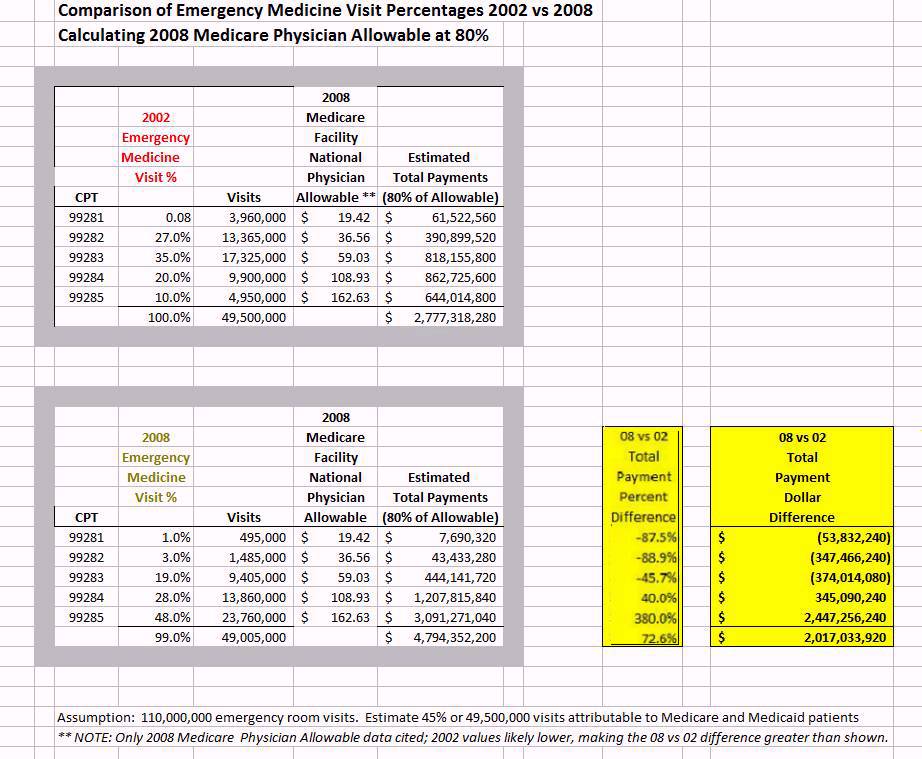
Second, a spreadsheet with some estimated numbers:


(Click to enlarge)


There appears to be an absolute increase in Medicare/Medicaid payments to ER doctors due to this billing-upcoding phenomenon from 2002 to 2008 (roughly $2 billion in payments, which at 80% allowed Medicare rate represents appx. a $2.6 Billion increase in billing)

The 2006-2008 billing levels for each specialty are public info on the CMS website. The hard part was obtaining earlier numbers. These were found in 2 papers from 2004 and 2006:

Variation in Coding of Evaluation and Management (E&M) Services by Hospital Emergency Departments
Paul Shoemaker, FACHE, President and CEO
American Hospital Directory, Inc.
Jan. 2004
http://www.ahd.com/EMstudy040108.pdf


Variations and Trends in the Coding of Evaluation and Management (E&M) Services by Hospital Emergency Departments
Paul Shoemaker, FACHE
Leatrice Ford RN, BSN, CCS, Founder, ConsultCare Partners, LLC
May 2006
http://www.ahd.com/EMstudy060530.pdf

Apparently Shoemaker and Ford were able to get CMS data for 2002 and 2004 and draw the conclusions that while some hospitals and ER groups were undercoding, there was a significant level of upcoding occurring.

Note that the above projections assume the same Medicare physician allowables for 2002 and 2008; lesser values in 2002 (compared to 2008) would push the 2008 payment increases upward.

Finally, some actual ED screens from a major HIT vendor, McKesson, that "encourage" physicians to upcode.

The "coding engine" of this ED EHR system produces "recommendations" for "additional documentation" to support a higher level of coding. Such incentives themselves might be legitimate, but can create moral hazard - and the means, motive and opportunity for "playing with the coding a little bit" - if physicians' coding levels are monitored by their organizations.


(Click to enlarge. An abscess. ED EHR advising physician to "provide more documentation" in order to upcode from level 2 based on the data entered, to level 5 or maximum, via unknown algorithms. A "Correct Deficiencies" button brings up screens with selections a physician can click on to "support" the cybernetic upcoding.)


(Click to enlarge. In this example an ED physician is begin cybernetically cajoled - uh, "reminded" - to enter data to support upcoding a sprained ankle evaluation from a level 3 to a level 5.)


It should be remembered that increased ED coding levels by ED groups, often contractors to hospitals, may permit hospitals to increase their own billing charges for services rendered to the ED patients.

In summary:

  • With little solid evidence of major clinical benefit, ED physicians seem to be paradoxically "asked" to utilize distracting, often mission hostile, even hateful ED EHR systems that many despise, even in face of the critical nature of an ED environment and increased risks and liabilities that can occur with distractions such as data entry. This is a seeming paradox.
  • The ED physicians, after automated coding algorithms analyze the clinical data entered, may be "reminded" that if they fill in a few more details, the visit might be significantly upcoded.
  • Payers such as CMS have little or no way to ascertain the veracity of the additional entered information that may result.
  • The ED physicians' coding levels may be monitored by their employer(s) i.e., group or hospital compared to the "possible" coding levels suggested by the vendor software algorithms. ED EHR software makes this easy. This would create the means, motive and opportunity for upcoding, so as to prevent negative repercussions on a "low coding" doctor. (The ED physician who submitted this data claims that this is so in his organization, and in others.)
While the above is not a rigorous analysis, if it overall reflects the current situation with ED and other EHR's in the field in 2011, we may be seeing:

  • A significant explanation for "irrational exuberance" around health IT - which would actually not be so irrational after all (just unethical) - with potentially deadly results;
  • A highly systematic, major fraud participated in by major stakeholders, from software vendor to purchaser to clinical user to biller. This would represent a cybernetically-facilitated swindle of major (and growing) proportions; and
  • Claims of purported savings from health IT that we hear about from pundits and government officials being a rather pathetic joke.

Perhaps CMS (and other payers as well) could perform the needed rigorous investigation using their data and resources, to either confirm or disprove these findings. That's what we, the taxpayer, pay the government for.

-- SS

Does EHR-Incited Upcoding (Also Known as "Fraud") Need Investigation by CMS, And Could it Explain HIT Irrational Exuberance?

It has long puzzled me why an experimental technology that costs tens or hundreds of billions of dollars to roll out organizationally and nationally, that individual medical centers are spending upwards of $100 million or more upon, and that has a track record as poor as suggested in posts such as "An Updated Reading List on Health IT" and "MAUDE and HIT Risks: Mother Mary, What in God's Name is Going on Here?" is so popular.

At a Feb. 2010 post "A Lawsuit Over Healthcare IT Whistleblowing and Wrongful Discharge" I summed up other critical HIT issues succinctly, with abundant hyperlinks to other materials as below:

... I have written about health IT problems extensively on this blog and at my academic website on HIT failure. These include but are not limited to: medical informatics specialists ignored by nonclinician IT personnel [the link is to another case involving critical care]; inverted and paradoxical organizational structures where IT facilitators become HIT project leaders and clinical leaders become HIT project facilitators; ill-conceived and poorly implemented mission hostile health IT; perverse and in fact clinically cavalier IT "politics"; failure to obtain patient informed consent as if health IT is an elite world not subject to the same ethical obligations as medicine; probable violations of Joint Commission safety standards and hospital executive fiduciary obligations, and numerous others.

At a Jan. 2011 post "Healthcare IT Delirium" wrote that:

... On top of an irrational exuberance (see this blog query) largely unsupported by the literature (e.g. here), the technology is experimental, its rollout is a grand national experiment in social re-engineering of medicine, there is no patient informed consent, nobody is in control, and nobody is taking responsibility for regulating the domain despite known risks. The results will very likely reflect the Wild West free-for-all that is now extant.

Finally, at a Feb. 2011 post "An Updated Reading List on Health IT" I aggregated recent literature that sheds significant doubts on health IT beneficence.

Is the popularity of health IT as it exists in 2011 a paradox, or not?

When I was dealing with public employees in a transit authority several decades ago, I learned that mysterious circumstances and paradoxes were not paradoxes at all. The assumptions were simply wrong. Often, mysterious circumstances proved to be related to money (as in worker's comp fraud) and/or money related to [illegal] drugs.

Below are some charts and data from a HC Renewal reader, an ED physician, that may answer the mystery of the "irrational exuberance" exhibited by healthcare organizations towards clearly disruptive, medically risky and liability-provoking experimental technology. This is especially so in high risk areas such as an ED.

It should be noted that my recommendations as a CMIO a number of years ago in a very large regional medical center were that an ED would benefit best clinically from paper charts supplemented by document imaging, so that images of past charts could be instantly retrieved. ED's are busy places where clinicians have little time for distractions (such as computer data entry), but where access to past charts can be important. ED charts are also not generally very long or complex documents. Further, document imaging is a mature technology (e.g., Documentum).

Those ED recommendations still stand.

(Incidentally, a relative, injured in 2010 via an EHR issue, would certainly be in far better shape had this been the case. The error would not have occurred. I've worked in settings where document imaging systems were used.)

Note that the data and charts below are estimates only, pointing to a potentially huge problem -- with computer-assisted Medicare fraud implications -- if the projections are reasonable.

First, from the ED physician reader, a graph showing an increase in overall ED billing levels of 2002 versus 2008:

(E/M level increases, 2002 compared to 2008. Click to enlarge)


This appears to indicate a great increase in upper level (level 4 and 5) billings from 2002 to 2008 in ED's with increasing advent of EHR (part of this is likely due to "paper template" charting).

A very terse summary of these billing codes, for laypeople. Claims submitted to managed care organizations and States include the emergency levels of screening and treatment. They range from CPT 99281 ("straightforward medical decision making") to CPT 99285 ("medical decision making of high complexity"). These codes reflect not only the complexity of the treatment but also the time and difficulty of making a diagnosis:

  • 99281 - level 1 - very short visit - low level service, minimal charge
  • 99282 - level 2 - e.g. ankle sprain
  • 99283 - level 3 - limited focus history & physical exam performed, e.g. physisian evaluation with additional tests such as an x-ray.
  • 99284 - level 4 - significant history & physical exam performed, significant or major injury, often admission
  • 99825 - level 5 - significant time, e.g., 45 minutes to an hour spent by physician. (Note that considering that a high % of ED visits are using that code, it might be physically impossible for ED physicians to be spending this much time seeing each patient.)


Second, a spreadsheet with some estimated numbers:


(Click to enlarge)


There appears to be an absolute increase in Medicare/Medicaid payments to ER doctors due to this billing-upcoding phenomenon from 2002 to 2008 (roughly $2 billion in payments, which at 80% allowed Medicare rate represents appx. a $2.6 Billion increase in billing)

The 2006-2008 billing levels for each specialty are public info on the CMS website. The hard part was obtaining earlier numbers. These were found in 2 papers from 2004 and 2006:

Variation in Coding of Evaluation and Management (E&M) Services by Hospital Emergency Departments
Paul Shoemaker, FACHE, President and CEO
American Hospital Directory, Inc.
Jan. 2004
http://www.ahd.com/EMstudy040108.pdf


Variations and Trends in the Coding of Evaluation and Management (E&M) Services by Hospital Emergency Departments
Paul Shoemaker, FACHE
Leatrice Ford RN, BSN, CCS, Founder, ConsultCare Partners, LLC
May 2006
http://www.ahd.com/EMstudy060530.pdf

Apparently Shoemaker and Ford were able to get CMS data for 2002 and 2004 and draw the conclusions that while some hospitals and ER groups were undercoding, there was a significant level of upcoding occurring.

Note that the above projections assume the same Medicare physician allowables for 2002 and 2008; lesser values in 2002 (compared to 2008) would push the 2008 payment increases upward.

Finally, some actual ED screens from a major HIT vendor, McKesson, that "encourage" physicians to upcode.

The "coding engine" of this ED EHR system produces "recommendations" for "additional documentation" to support a higher level of coding. Such incentives themselves might be legitimate, but can create moral hazard - and the means, motive and opportunity for "playing with the coding a little bit" - if physicians' coding levels are monitored by their organizations.


(Click to enlarge. An abscess. ED EHR advising physician to "provide more documentation" in order to upcode from level 2 based on the data entered, to level 5 or maximum, via unknown algorithms. A "Correct Deficiencies" button brings up screens with selections a physician can click on to "support" the cybernetic upcoding.)


(Click to enlarge. In this example an ED physician is begin cybernetically cajoled - uh, "reminded" - to enter data to support upcoding a sprained ankle evaluation from a level 3 to a level 5.)


It should be remembered that increased ED coding levels by ED groups, often contractors to hospitals, may permit hospitals to increase their own billing charges for services rendered to the ED patients.

In summary:

  • With little solid evidence of major clinical benefit, ED physicians seem to be paradoxically "asked" to utilize distracting, often mission hostile, even hateful ED EHR systems that many despise, even in face of the critical nature of an ED environment and increased risks and liabilities that can occur with distractions such as data entry. This is a seeming paradox.
  • The ED physicians, after automated coding algorithms analyze the clinical data entered, may be "reminded" that if they fill in a few more details, the visit might be significantly upcoded.
  • Payers such as CMS have little or no way to ascertain the veracity of the additional entered information that may result.
  • The ED physicians' coding levels may be monitored by their employer(s) i.e., group or hospital compared to the "possible" coding levels suggested by the vendor software algorithms. ED EHR software makes this easy. This would create the means, motive and opportunity for upcoding, so as to prevent negative repercussions on a "low coding" doctor. (The ED physician who submitted this data claims that this is so in his organization, and in others.)
While the above is not a rigorous analysis, if it overall reflects the current situation with ED and other EHR's in the field in 2011, we may be seeing:

  • A significant explanation for "irrational exuberance" around health IT - which would actually not be so irrational after all (just unethical) - with potentially deadly results;
  • A highly systematic, major fraud participated in by major stakeholders, from software vendor to purchaser to clinical user to biller. This would represent a cybernetically-facilitated swindle of major (and growing) proportions; and
  • Claims of purported savings from health IT that we hear about from pundits and government officials being a rather pathetic joke.

Perhaps CMS (and other payers as well) could perform the needed rigorous investigation using their data and resources, to either confirm or disprove these findings. That's what we, the taxpayer, pay the government for.

-- SS

Monday, January 10, 2011

Executive Compensation at Non-Profit Hospitals: Pay for ... Fraud?

We have often discussed executive compensation at US hospitals and academic medical centers, which seems to run from generous to outrageous.  The usual explanation by organizational spokespeople, and occasionally boards of trustees is that this is the sort of compensation needed to attract the best and the brightest, a variation of the "pay for performance" meme that resounds throughout business schools and executive suites.  However, almost never does anyone at any hospital or AMC acknowledge that their leaders are not the best and brightest, although outside of Lake Woebegone, all cannot be above average.

Here are two recent stories about hospital executives whose compensation contrasted with their performance.

Danbury Hospital

We previously posted about how the former chief financial officer (CFO) of Danbury Hospital, now part of Western Connecticut Healthcare, was found in violation of a no-contact order that arose after he was charged with multiple counts of fraud.  It turns out that the William Roe, the former CFO, previously was paid $267,990, per the Danbury News-Times

This month, again according to the News-Times, he pleaded guilty:
William Roe, the former chief financial officer of Danbury Hospital arrested in August and charged with defrauding the hospital out of more than $100,000, pleaded guilty Tuesday to one count of wire fraud.

The plea reduces the charges against Roe. In September, in addition to the wire fraud charges, federal prosecutors charged him with two counts of interstate transportation of stolen money. Those charges have been dropped as part of the plea deal.

Along with the guilty plea, Roe has agreed to reimburse Danbury Hospital more than $140,000. He also will reimburse St. Rita Hospital in Lima, Ohio, where he worked as CFO before coming to Danbury Hospital, an additional $75,000 for funds he allegedly stole there.

Archbold Memorial Hospital

This is one of those cases it would be hard to make up. The Dow Jones News Service originally reported in December, 2010:
A Georgia hospital paid $13.9 million to settle allegations it submitted false claims to the state's Medicaid program, the Justice Department said Wednesday.

The settlement resolves allegations that between November 2002 and July 2008, Thomasville, Ga., John D. Archbold Memorial Hospital Inc. made false representations to the Georgia Department of Community Health, the state agency that administers the Medicaid program in Georgia, that it was a public hospital for Medicaid purposes in order to increase the amount of funds provided to the hospital.

Under Medicaid rules, only public hospitals may participate in the Medicaid Upper Payment Limit, or UPL program. Contrary to its state certification, Archbold Memorial was in fact a private hospital, the Justice Department said, and as a result received millions of dollars in funds to which it was not entitled.
A private not-for-profit hospital claimed to be a public hospital to Medicaid?  And it took years for anyone to figure out that was not the case?  It would have been hard to make that one up.
Two executives took the rap:
in early 2008, then-Chief Financial Officer William Sellers resigned after a three-month suspension and pleaded guilty to charges related to his role in the matter. Former Chief Executive Ken Beverly, who also resigned in February of that year, was recently convicted on charges regarding his involvement.

The Albany (Georgia) Herald reported that Mr Beverly did quite well between the time of his resignation and his conviction:
Former CEO Ken Beverly resigned from his post in 2008 and walked away with more than $6.1 million in compensation and benefits. He was later indicted by a federal grand jury.

Convicted Dec. 8, 2010, of six felony counts related to an indictment alleging he was part of a scheme to defraud Medicaid, Beverly remains free on bond and is awaiting a sentencing hearing.

So is that $1 million per felony count? At least we can be assured it was not a "golden parachute,"
Archbold Spokesman Mark Lowe said that the figure as noted in the hospital’s Form 990 for 2009 as filed with the IRS on August 2010 is the sum of Beverly’s deferred compensation and benefits package as it has accumulated over the course of his 30-plus year career with the hospital and was not a 'golden parachute,' as described in some media reports.

'The ‘other compensation’ is from his retirement program that accumulated deferred compensation over the entire term of his employment. In his case, that was in excess of 30 years of deferred compensation. It’s not severance; rather, it’s compensation that was earned but not paid out until retirement,' Lowe said.

Well, that is reassuring.  Of course, regardless of what you call the payment, a lump sum of $6.1 million is far more than most citizens ever will get for their retirement from any employer.  Having $6.1 million in one's retirement account would fit most peoples' definition of "rich." 

Summary

Again, almost all hospital and academic medical center executives seem to be well-paid, even if they work at small institutions, or at those with shaky finances. When their pay is noticed by the news media, the usual explanation is the executives' general brilliance and excellence, with little more than more vague adjectives supplied in justification.

Given the lack of clear evidence for most executives' large compensation, I believe it is reasonable to cite anecdotes where generous compensation was obviously, if retrospectively coupled with poor performance to challenge the rationale for ever-increasing executive compensation in health care. The two cases above are not of merely poor, but criminal performance, and so stand out.

As we have said before, far too often the leaders of not-for-profit health care institutions seem more interested in padding their own bottom lines than upholding the institutions' missions. They often seem entirely unaware of their duty to put those missions ahead of their own self-interest. Like the financial services sector in the era of "greed is good," health care too often seems run by "insiders hijacking established institutions for their personal benefit." True health care reform would encourage leadership of health care who understand health care and care about its mission, rather than those who see a quick way to make a small fortune.

Executive Compensation at Non-Profit Hospitals: Pay for ... Fraud?

We have often discussed executive compensation at US hospitals and academic medical centers, which seems to run from generous to outrageous.  The usual explanation by organizational spokespeople, and occasionally boards of trustees is that this is the sort of compensation needed to attract the best and the brightest, a variation of the "pay for performance" meme that resounds throughout business schools and executive suites.  However, almost never does anyone at any hospital or AMC acknowledge that their leaders are not the best and brightest, although outside of Lake Woebegone, all cannot be above average.

Here are two recent stories about hospital executives whose compensation contrasted with their performance.

Danbury Hospital

We previously posted about how the former chief financial officer (CFO) of Danbury Hospital, now part of Western Connecticut Healthcare, was found in violation of a no-contact order that arose after he was charged with multiple counts of fraud.  It turns out that the William Roe, the former CFO, previously was paid $267,990, per the Danbury News-Times

This month, again according to the News-Times, he pleaded guilty:
William Roe, the former chief financial officer of Danbury Hospital arrested in August and charged with defrauding the hospital out of more than $100,000, pleaded guilty Tuesday to one count of wire fraud.

The plea reduces the charges against Roe. In September, in addition to the wire fraud charges, federal prosecutors charged him with two counts of interstate transportation of stolen money. Those charges have been dropped as part of the plea deal.

Along with the guilty plea, Roe has agreed to reimburse Danbury Hospital more than $140,000. He also will reimburse St. Rita Hospital in Lima, Ohio, where he worked as CFO before coming to Danbury Hospital, an additional $75,000 for funds he allegedly stole there.

Archbold Memorial Hospital

This is one of those cases it would be hard to make up. The Dow Jones News Service originally reported in December, 2010:
A Georgia hospital paid $13.9 million to settle allegations it submitted false claims to the state's Medicaid program, the Justice Department said Wednesday.

The settlement resolves allegations that between November 2002 and July 2008, Thomasville, Ga., John D. Archbold Memorial Hospital Inc. made false representations to the Georgia Department of Community Health, the state agency that administers the Medicaid program in Georgia, that it was a public hospital for Medicaid purposes in order to increase the amount of funds provided to the hospital.

Under Medicaid rules, only public hospitals may participate in the Medicaid Upper Payment Limit, or UPL program. Contrary to its state certification, Archbold Memorial was in fact a private hospital, the Justice Department said, and as a result received millions of dollars in funds to which it was not entitled.
A private not-for-profit hospital claimed to be a public hospital to Medicaid?  And it took years for anyone to figure out that was not the case?  It would have been hard to make that one up.
Two executives took the rap:
in early 2008, then-Chief Financial Officer William Sellers resigned after a three-month suspension and pleaded guilty to charges related to his role in the matter. Former Chief Executive Ken Beverly, who also resigned in February of that year, was recently convicted on charges regarding his involvement.

The Albany (Georgia) Herald reported that Mr Beverly did quite well between the time of his resignation and his conviction:
Former CEO Ken Beverly resigned from his post in 2008 and walked away with more than $6.1 million in compensation and benefits. He was later indicted by a federal grand jury.

Convicted Dec. 8, 2010, of six felony counts related to an indictment alleging he was part of a scheme to defraud Medicaid, Beverly remains free on bond and is awaiting a sentencing hearing.

So is that $1 million per felony count? At least we can be assured it was not a "golden parachute,"
Archbold Spokesman Mark Lowe said that the figure as noted in the hospital’s Form 990 for 2009 as filed with the IRS on August 2010 is the sum of Beverly’s deferred compensation and benefits package as it has accumulated over the course of his 30-plus year career with the hospital and was not a 'golden parachute,' as described in some media reports.

'The ‘other compensation’ is from his retirement program that accumulated deferred compensation over the entire term of his employment. In his case, that was in excess of 30 years of deferred compensation. It’s not severance; rather, it’s compensation that was earned but not paid out until retirement,' Lowe said.

Well, that is reassuring.  Of course, regardless of what you call the payment, a lump sum of $6.1 million is far more than most citizens ever will get for their retirement from any employer.  Having $6.1 million in one's retirement account would fit most peoples' definition of "rich." 

Summary

Again, almost all hospital and academic medical center executives seem to be well-paid, even if they work at small institutions, or at those with shaky finances. When their pay is noticed by the news media, the usual explanation is the executives' general brilliance and excellence, with little more than more vague adjectives supplied in justification.

Given the lack of clear evidence for most executives' large compensation, I believe it is reasonable to cite anecdotes where generous compensation was obviously, if retrospectively coupled with poor performance to challenge the rationale for ever-increasing executive compensation in health care. The two cases above are not of merely poor, but criminal performance, and so stand out.

As we have said before, far too often the leaders of not-for-profit health care institutions seem more interested in padding their own bottom lines than upholding the institutions' missions. They often seem entirely unaware of their duty to put those missions ahead of their own self-interest. Like the financial services sector in the era of "greed is good," health care too often seems run by "insiders hijacking established institutions for their personal benefit." True health care reform would encourage leadership of health care who understand health care and care about its mission, rather than those who see a quick way to make a small fortune.

Monday, December 27, 2010

Hackensack University Medical Center CEO's $5 Million Golden Parachute: "the Public Will Perceive the Institution as a Kind of Insider's Group"

Last year was an embarassing one for Hackensack University Medical Center (HUMC), a large academic medical center affiliated with the University of Medicine and Dentistry of New Jersey.  In April, former state senator Joseph Coniglio was convicted of fraud (against the public) and extortion for a scheme that involved him being paid $5000 a month for undefined consulting work for HUMC while he promoted the hospital's interests in the state legislature (see post here).  A subsequent investigative report revealed widespread self-dealing on the part of the HUMC board (see post here).  Soon after, the HUMC CEO, John Ferguson, announced his retirement, per the Newark Star-Ledger.

Scandal Leads to Apparent Reforms

So when I read an article from last week on NorthJersey.com entitled "Hackensack University Medical Center works to revamp reputation hurt by trial" I hoped that these travails lead to some real improvements in the leadership and governance of the institution.  Hope springs eternal, and the article did describe some apparent progress.

The medical center's board of trustees was streamlined:
the hospital's board of governors — once a 57-member behemoth run by a core group of powerful and politically connected members — was whittled to less than half its former size and is now overseen by what the hospital is calling a 'reinvigorated' parent company, Hillcrest Health Service System Inc.

Conflicts of interest and self-dealing were apparently banned
Members of the two boards may no longer do business directly with the hospital — a significant change because some of them own or work for companies that have been paid millions of dollars by Hackensack. In 2009 alone, these companies were paid $13.2 million by the hospital, according to its federal tax filings. They were paid $17.4 million in 2008.
The Devil in the Details
Although the board was reduced in size, it gained almost no new members, and the politically-connected members who previously were accused of self-dealing remained:
Serving as chairman of the board of governors is Joseph M. Sanzari, a construction magnate, multimillion-dollar donor and longtime board member. His company, a joint venture with former board Chairman J. Fletcher Creamer Jr., has been one of the highest-paid independent contractors at the medical center.

Also,
There were no new board members until Tuesday, when two were appointed. Many who held influential positions on the board of governors — including Sanzari, Creamer and Joseph Simunovich — are still in key roles.

Furthermore, there was a big loop-hole in the apparent ban on conflicts of interest and self-dealing:
members of both the board of governors and Hillcrest can still do business with the hospital as long as they work as subcontractors or move to the foundation board or a newly created advisory panel that doesn't have voting or fiduciary powers.

Also,
Members of the board of governors and Hillcrest still can be hired as subcontractors.

The ban on doing business with the hospital also doesn't cover members of the advisory panel or the board that oversees the foundation. About a dozen members of these two groups are affiliated with companies that have made money — millions, in some cases – in work with the hospital.

As one outside expert noted,
'They may have changed the structure, but if you don't change the people, you don't change the culture,' said Jamie Orlikoff, a governance expert who advises the National Hospital Association.

Furthermore,
'People who had influence and clout when they were members of a fiduciary board will still have influence and clout even if they are moved to an advisory board,' Orlikoff said.

So,
'The concern is that the public will perceive the institution as a kind of insider's group and things are being done to benefit them,' said Daniel Borochoff, president of the American Institute of Philanthropy.
The CEO's Golden Parachute

Hope spring eternal, but is too often crushed.  However, at least the former CEO is gone. But it turns out he got quite a going away present. As described in a companion article,
John P. Ferguson received a severance package of more than $5 million when he was forced out as president of Hackensack University Medical Center last year, bringing his total compensation for 2009 to $7.7 million, according to recent federal tax filings.

The other executives who presided over HUMC in 2009, the year that its former consultant was convicted, also did very well for themselves,
His senior vice president for operations, Doreen Santora, received $2.6 million — including more than $1.5 million in severance — when she left in the executive reshuffling that followed, the documents show.

In all, seven top executives at the non-profit hospital each received more than $1 million in total compensation in 2009, up from five the year before.

This extremely generous compensation could not be related to the financial success of the hospital at the time:
The compensation packages came in a year in which tax filings show the 775-bed medical center employed 317 fewer staff and Moody's Investors Service downgraded its credit rating to Baa1, leading to higher interest payments when new debt is issued.

If this was pay for performance, by what measure these executives' performance was measured was not clear. Actually, who even decided to award them such sumptuous pay was unclear:
only a handful of board members were aware of the millions of dollars in pay and perks that had been handed out to executives over the last few years. Several employees saw their overall compensation double or triple.

Board members expressed 'sticker shock' when they first learned of the compensation numbers at a fall 2009 meeting, said J. Fletcher Creamer Jr., who completed his term as chairman of the board of governors in March.

'We went through every single executive' whose salaries must be disclosed on the IRS form for non-profit institutions, Creamer said in an interview earlier this year. 'It's the first time they actually saw it. … We always made the numbers available if they wanted to come see it, but not everyone looked.'

Keep in mind that per the first NorthJersey.com article, Mr Creamer will still be in a "key role" at HUMC, his failure to think that top executives' compensation was something his fellow board members needed to consider notwithstanding.

Summary

Is this any way to run a hospital "which has a national reputation for quality care?" The hospital leadership did and still appears to be an "insider's group" which works to promote its own self-interest.

As we have said before, far too often the leaders of not-for-profit health care institutions seem more interested in padding their own bottom lines than upholding the institutions' missions. They often seem entirely unaware of their duty to put those missions ahead of their own self-interest. Like the financial services sector in the era of "greed is good," health care too often seems run by "insiders hijacking established institutions for their personal benefit." True health care reform would encourage leadership of health care who understand health care and care about its mission, rather than those who see a quick way to make a small fortune.

Hackensack University Medical Center CEO's $5 Million Golden Parachute: "the Public Will Perceive the Institution as a Kind of Insider's Group"

Last year was an embarassing one for Hackensack University Medical Center (HUMC), a large academic medical center affiliated with the University of Medicine and Dentistry of New Jersey.  In April, former state senator Joseph Coniglio was convicted of fraud (against the public) and extortion for a scheme that involved him being paid $5000 a month for undefined consulting work for HUMC while he promoted the hospital's interests in the state legislature (see post here).  A subsequent investigative report revealed widespread self-dealing on the part of the HUMC board (see post here).  Soon after, the HUMC CEO, John Ferguson, announced his retirement, per the Newark Star-Ledger.

Scandal Leads to Apparent Reforms

So when I read an article from last week on NorthJersey.com entitled "Hackensack University Medical Center works to revamp reputation hurt by trial" I hoped that these travails lead to some real improvements in the leadership and governance of the institution.  Hope springs eternal, and the article did describe some apparent progress.

The medical center's board of trustees was streamlined:
the hospital's board of governors — once a 57-member behemoth run by a core group of powerful and politically connected members — was whittled to less than half its former size and is now overseen by what the hospital is calling a 'reinvigorated' parent company, Hillcrest Health Service System Inc.

Conflicts of interest and self-dealing were apparently banned
Members of the two boards may no longer do business directly with the hospital — a significant change because some of them own or work for companies that have been paid millions of dollars by Hackensack. In 2009 alone, these companies were paid $13.2 million by the hospital, according to its federal tax filings. They were paid $17.4 million in 2008.
The Devil in the Details
Although the board was reduced in size, it gained almost no new members, and the politically-connected members who previously were accused of self-dealing remained:
Serving as chairman of the board of governors is Joseph M. Sanzari, a construction magnate, multimillion-dollar donor and longtime board member. His company, a joint venture with former board Chairman J. Fletcher Creamer Jr., has been one of the highest-paid independent contractors at the medical center.

Also,
There were no new board members until Tuesday, when two were appointed. Many who held influential positions on the board of governors — including Sanzari, Creamer and Joseph Simunovich — are still in key roles.

Furthermore, there was a big loop-hole in the apparent ban on conflicts of interest and self-dealing:
members of both the board of governors and Hillcrest can still do business with the hospital as long as they work as subcontractors or move to the foundation board or a newly created advisory panel that doesn't have voting or fiduciary powers.

Also,
Members of the board of governors and Hillcrest still can be hired as subcontractors.

The ban on doing business with the hospital also doesn't cover members of the advisory panel or the board that oversees the foundation. About a dozen members of these two groups are affiliated with companies that have made money — millions, in some cases – in work with the hospital.

As one outside expert noted,
'They may have changed the structure, but if you don't change the people, you don't change the culture,' said Jamie Orlikoff, a governance expert who advises the National Hospital Association.

Furthermore,
'People who had influence and clout when they were members of a fiduciary board will still have influence and clout even if they are moved to an advisory board,' Orlikoff said.

So,
'The concern is that the public will perceive the institution as a kind of insider's group and things are being done to benefit them,' said Daniel Borochoff, president of the American Institute of Philanthropy.
The CEO's Golden Parachute

Hope spring eternal, but is too often crushed.  However, at least the former CEO is gone. But it turns out he got quite a going away present. As described in a companion article,
John P. Ferguson received a severance package of more than $5 million when he was forced out as president of Hackensack University Medical Center last year, bringing his total compensation for 2009 to $7.7 million, according to recent federal tax filings.

The other executives who presided over HUMC in 2009, the year that its former consultant was convicted, also did very well for themselves,
His senior vice president for operations, Doreen Santora, received $2.6 million — including more than $1.5 million in severance — when she left in the executive reshuffling that followed, the documents show.

In all, seven top executives at the non-profit hospital each received more than $1 million in total compensation in 2009, up from five the year before.

This extremely generous compensation could not be related to the financial success of the hospital at the time:
The compensation packages came in a year in which tax filings show the 775-bed medical center employed 317 fewer staff and Moody's Investors Service downgraded its credit rating to Baa1, leading to higher interest payments when new debt is issued.

If this was pay for performance, by what measure these executives' performance was measured was not clear. Actually, who even decided to award them such sumptuous pay was unclear:
only a handful of board members were aware of the millions of dollars in pay and perks that had been handed out to executives over the last few years. Several employees saw their overall compensation double or triple.

Board members expressed 'sticker shock' when they first learned of the compensation numbers at a fall 2009 meeting, said J. Fletcher Creamer Jr., who completed his term as chairman of the board of governors in March.

'We went through every single executive' whose salaries must be disclosed on the IRS form for non-profit institutions, Creamer said in an interview earlier this year. 'It's the first time they actually saw it. … We always made the numbers available if they wanted to come see it, but not everyone looked.'

Keep in mind that per the first NorthJersey.com article, Mr Creamer will still be in a "key role" at HUMC, his failure to think that top executives' compensation was something his fellow board members needed to consider notwithstanding.

Summary

Is this any way to run a hospital "which has a national reputation for quality care?" The hospital leadership did and still appears to be an "insider's group" which works to promote its own self-interest.

As we have said before, far too often the leaders of not-for-profit health care institutions seem more interested in padding their own bottom lines than upholding the institutions' missions. They often seem entirely unaware of their duty to put those missions ahead of their own self-interest. Like the financial services sector in the era of "greed is good," health care too often seems run by "insiders hijacking established institutions for their personal benefit." True health care reform would encourage leadership of health care who understand health care and care about its mission, rather than those who see a quick way to make a small fortune.